Prerequisites:
Basic Computer Literacy: Students should be familiar with basic computer operations, such as file management and using a text editor.
Logical Aptitude: A capacity for logical and analytical thinking is beneficial.
No prior programming experience is required. This course is designed for beginners.
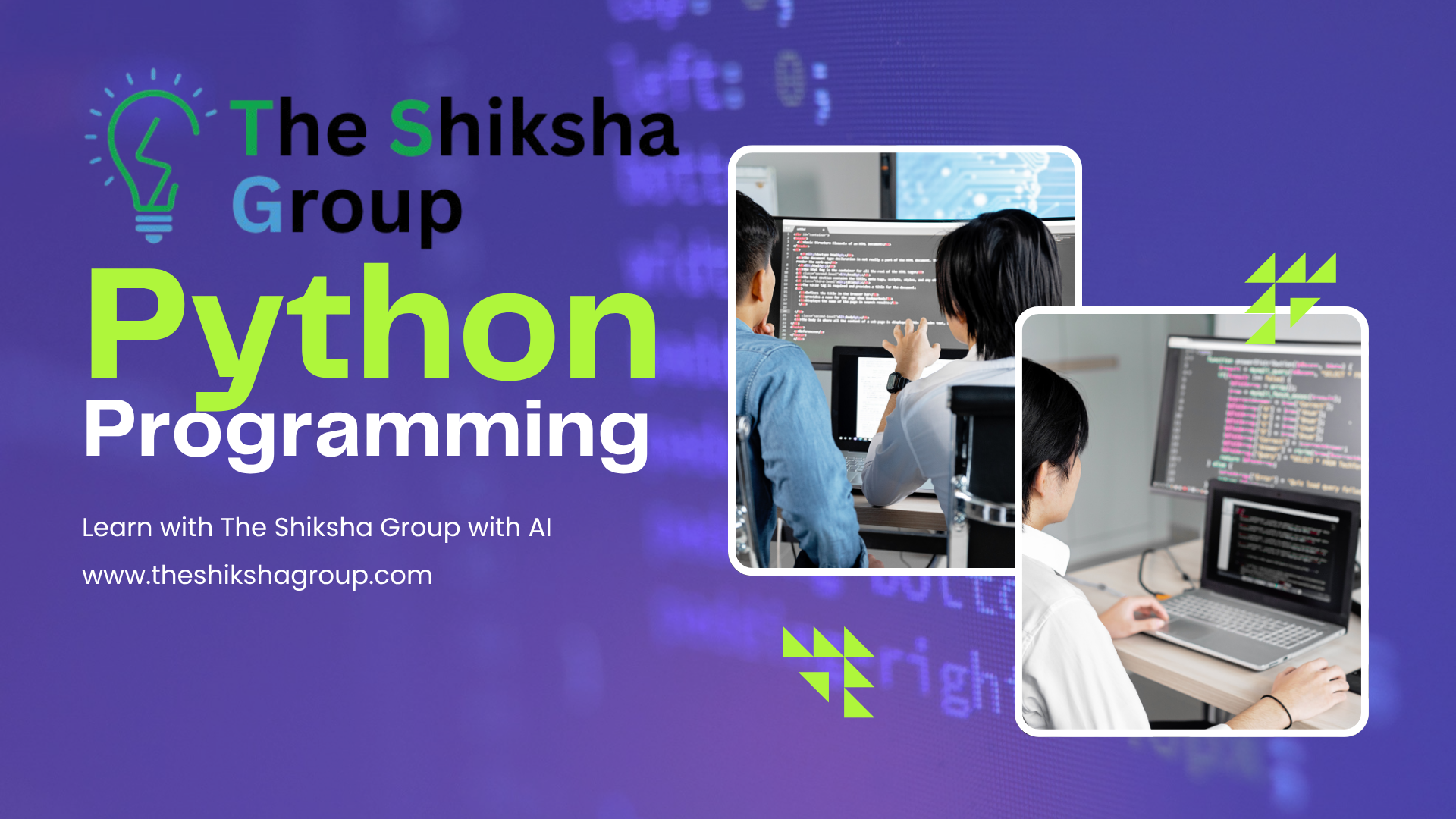
is course aims to equip students with the fundamental knowledge and skills needed to effectively utilize Python as a powerful and versatile programming language. The curriculum covers core programming concepts, including syntax, data types, control flow, functions, and data structures. It also introduces students to object-oriented programming (OOP) principles and file handling. Upon completion, students will have a solid foundation in Python, enabling them to write code independently, contribute to Python-based projects, and pursue further specialization in areas like data analysis, web development, or automation.
Upon successful completion of this course, students will be able to:
CO1: Master Fundamentals: Gain a solid understanding of Python programming fundamentals, including syntax, data types, control structures, and functions.
CO2: Design Modular Programs: Be able to design and implement modular programs using functions and modules to improve code reusability and maintainability.
CO3: Handle Data and Files: Become capable of reading from and writing to files, as well as handling different file formats for data input and output operations.
CO4: Apply Object-Oriented Principles: Understand the principles of object-oriented programming (OOP) and be able to create classes, objects, and inheritance hierarchies to model real-world problems.
CO5: Utilize Core Data Structures: Proficiently use Python's built-in data structures like lists, tuples, and dictionaries to store and manipulate data collections.
Introduction: Features of Python, The Python Virtual Machine (PVM), Memory Management.
Python Tokens: Keywords, Identifiers, Literals, Operators, Punctuators.
Variables, Assignments, and Comments.
Data Types: Numbers, Strings, Booleans.
Mutable and Immutable Types.
Operators: Arithmetic, Relational, Logical, Bitwise, Assignment.
Expression Evaluation and Type Casting.
Conditional Statements: if, if-else, if-elif-else.
Looping Constructs: for loops, while loops, range() function.
Loop Control: break, continue, pass.
Strings: Traversing, Slicing, Concatenation, Membership operators.
Built-in String Methods: len(), capitalize(), find(), split(), join(), strip(), etc.
Functions: Defining and calling functions, return statement.
Arguments: Positional, Default, Keyword, Variable-length.
Scope: Local and Global variables.
Lambda Functions: lambda with filter() and map().
Lists: Creating lists, indexing, slicing, traversing.
List Operations and Methods: append(), extend(), insert(), pop(), remove(), sort(), reverse().
List Comprehensions and 2D lists.
Tuples: Creating tuples, accessing elements, immutability.
Tuple operations and methods.
Dictionaries: Creating dictionaries, adding and accessing key-value pairs.
Dictionary Operations and Methods: keys(), values(), items(), get(), update(), pop().
Traversing a dictionary.
Opening and Closing Files: open() function, with statement.
File Modes: r, w, a, r+, w+, a+.
Writing to Files: write(), writelines().
Reading from Files: read(), readline(), readlines().
File Pointer Manipulation: seek(), tell().
Features of OOP.
Classes and Objects: self variable, constructors (__init__).
Class variables vs. Instance variables.
Methods: Instance, Class, and Static methods.
Inheritance: Types of inheritance, super(), Method Resolution Order (MRO).
Polymorphism: Operator and Method Overloading.
No Review found
Discover Additional Learning Opportunities
 Static
 Static
 Static
 Static